

Traveling in retirement isn’t just something to fill your calendar. It’s often the piece that makes the whole next chapter make sense. Here’s why.
Nobody really warns you about the quiet.
You spend forty-some years climbing toward something, a title, a pension, a Friday afternoon that finally means something. And then one day it arrives, and the structure that shaped every one of your days simply… stops. No more ladder. No more next rung. Just an open calendar and a question nobody quite prepared you to answer: now what?
Most of the big life transitions come with a built-in next step. School leads to a career. A first job leads to a promotion. Even parenting, as all-consuming as it is, has its own next chapter waiting on the other side. Retirement is different. It’s the one milestone that hands you the finish line and the starting line on the same day, in the same envelope, with no instructions.
What’s missing?
That gap — the one between “the career is over” and “the next thing hasn’t been decided yet” — is where traveling in retirement tends to show up. Not as a bucket-list luxury. Not as something you do once and check off. But as the thing that quietly starts filling the space where the ladder used to be.
We didn’t expect that. We assumed travel would be a nice bonus of retirement, just as a long weekend is a nice bonus of a busy year. What we didn’t expect was how much it would end up structuring our time, our conversations, even the way we thought about the years still ahead of us.
That’s what the video below gets into — and it’s also where our own version of that story started to take shape, on a ship in the Pacific, closer to answers than we expected.
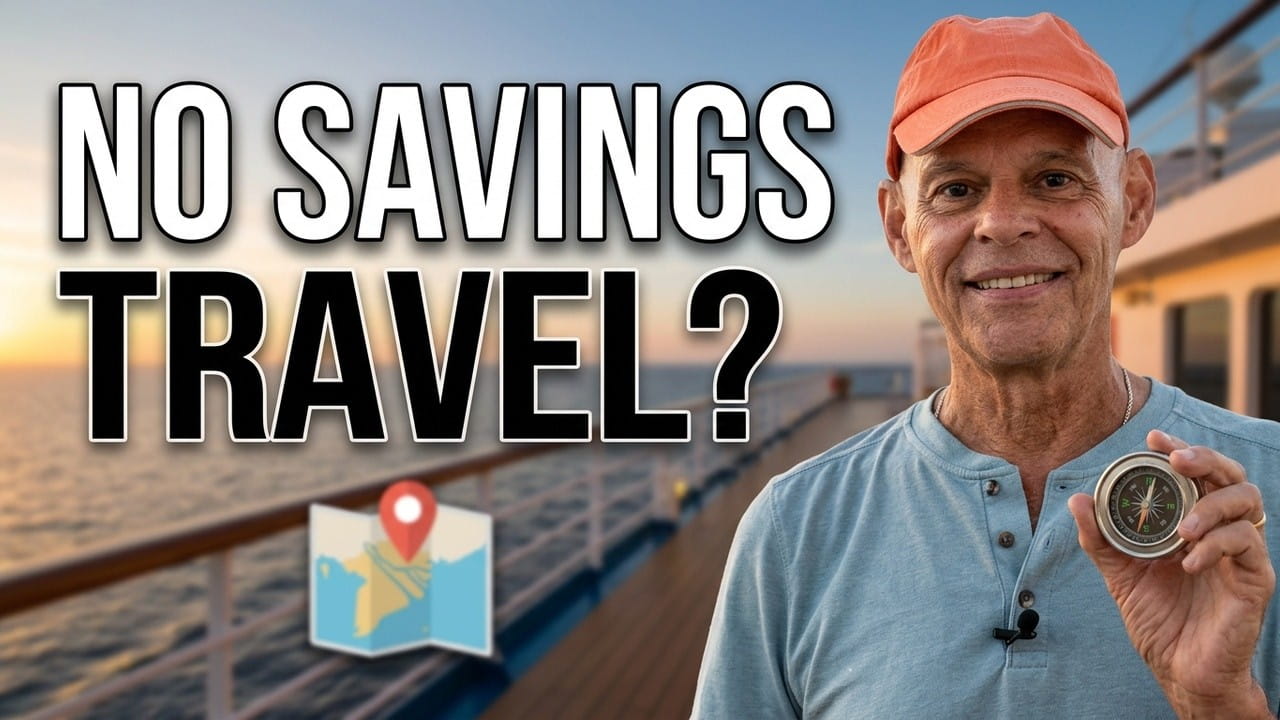
Watch: What Traveling in Retirement Actually Looks Like for Us
What forty years of unanswered questions, and one cruise out of Tokyo, taught us about traveling in retirement.
Before you press play ▶️, a few things you won’t find anywhere else on this page: the story behind a question that took four decades to answer, the one financial trap every first-time cruiser should know about, and why we chose this particular ship for a very particular anniversary.
Traveling in retirement isn’t really the destination of this story. It’s the ongoing chapter. The trips add up, the questions get answered, and slowly the blank page that retirement hands you starts to fill in on its own terms.
If the video above resonated, the free training linked in the description is the natural next step, not a sales pitch, just the practical piece that makes this kind of ongoing travel financially sustainable rather than a one-time splurge.
The Part Nobody Talks About: Retirement Doesn’t Come With a Map
Here’s something worth sitting with for a second: almost every stage of adult life is designed by someone else. School systems, career ladders, mortgage schedules- they all come with a shape already built in. Retirement is the first major chapter you have to design yourself, from a blank page, usually while everyone around you assumes you already have it figured out.
That’s a big reason traveling in retirement resonates the way it does. It’s not really about the destination. It’s about handing yourself a structure again, something to plan for, look forward to, and organize a season of life around. A trip in six weeks gives shape to the six weeks before it. A cruise booked for the fall gives you something to train for, save for, and talk about at dinner.
We’ve heard some version of this from almost every retired couple we’ve met on the road. One pair we met, married nearly as long as we have been, told us they didn’t fully understand how much they’d miss having deadlines until they didn’t have any. Booking their first cruise, they said, was the first time in a year they’d circled a date on the calendar and felt that old familiar pull of something coming up.
It’s a small thing. But small things matter more than we expect once the big structure of a career disappears.
Learning to Travel on a Different Clock
There’s another shift that happens somewhere in your 60s or 70s that doesn’t get talked about enough: the trip itself has to change shape, even if the desire to see the world hasn’t changed at all.
In your 30s, travel is often about covering ground — more cities, tighter schedules, red-eye flights you shake off by lunch. That calculus doesn’t hold up the same way later on, and pretending it does is usually how people end up exhausted rather than fulfilled.
What tends to work better is pacing a trip around energy rather than itinerary. Building in a slow morning between two full days. Choosing a stateroom with a view worth waking up early for, rather than one that’s simply cheapest. Packing less, but packing smarter: the right shoes for uneven cobblestones, layers for ships that run cold in the dining rooms and warm on deck, a printed copy of anything important in case a phone battery has other plans.
None of this makes the travel smaller. If anything, it makes room for the parts that matter most, the tunnel that finally answers a question, the port town that turns out to be the highlight of the whole trip, the sunset toast nobody had scheduled but everyone remembers.
Is a Cruise the Right Way for You to Start?
Not every traveler is a cruise traveler, and that’s fine. But if you’re weighing it, a few honest questions tend to cut through the noise faster than any list of pros and cons:
Do you want fewer logistics decisions, or more control over each one? Cruising trades some control for a level of ease that a lot of retirees find, somewhat to their own surprise, is exactly what they wanted all along.
Are you traveling to relax, or traveling to explore intensely? Both are valid. Cruising tends to serve the first beautifully and the second reasonably well, with the right excursions chosen carefully.
Is this trip marking something? An anniversary, a retirement itself, a milestone birthday — cruising has a way of giving those occasions room to breathe that a rushed, self-planned itinerary sometimes doesn’t.
There’s no wrong answer here. But sitting with these questions honestly, before booking anything, tends to save both money and disappointment.
Where This Leads
Traveling in retirement isn’t really the destination of this story; it’s the ongoing chapter. The trips add up, the questions get answered, and slowly the blank page that retirement hands you starts to fill in on its own terms.
If the video above resonated, the free training linked in the description is the natural next step — not a sales pitch, just the practical piece that makes this kind of ongoing travel financially sustainable rather than a one-time splurge.
Related reading:
- Reinvent Yourself After 60 Is Not About Starting Over
- The Finding Purpose in Life After 60, 70 and Beyond
I‘d love to hear from you: what’s the one place traveling in retirement has finally taken you to, or the one you’re still working toward? Drop it in the comments below.
—
Want to stay up to date on new posts just like this one?
and get the latest posts automatically via email

Jan O. Nilsson –Traveling in Retirement: Why It Becomes the Thing You Didn’t Plan For, But Needed <== to the top of the page
Follow me: