

If you’ve ever caught yourself thinking “I’m too old for this now,” you’re not alone, and you’re also not right. Age matters when you’re building a business. Just maybe not in the direction you assumed.
Here’s a number worth sitting with: adults over 55 now start businesses at a higher rate than any other age group in the U.S., according to the Kauffman Foundation’s entrepreneurship research. Meanwhile, the median age of founders behind the fastest-growing startups isn’t 25. It’s closer to 45, and climbing.
So why does the “too old to start” myth persist? Mostly because we’ve been shown the wrong role models. Silicon Valley loves a 22-year-old in a hoodie. But the data tells a different story, one where age isn’t the obstacle; it’s often the edge.
Why Age Matters More Than Ever Right Now
A few forces are colliding at once in 2026:
- Retirement gaps are real. Many people reaching 60+ are realizing pensions and savings won’t stretch as far as planned, and a flexible income stream matters more than ever.
- Longer, healthier lifespans mean that a “retirement” at 62 could realistically span 25–30 more active years… plenty of runway to build something new.
- The “encore career” movement has gone mainstream, with more resources, communities, and platforms built specifically for career-changers and second-act founders than existed even five years ago.
Put simply: the environment has never been friendlier to a senior entrepreneur than it is right now.
Watch the Full Breakdown
I put together a full video that explains why age works in your favor as an entrepreneur, including the exact turning point that led me to start my own business at 62 with zero online experience.
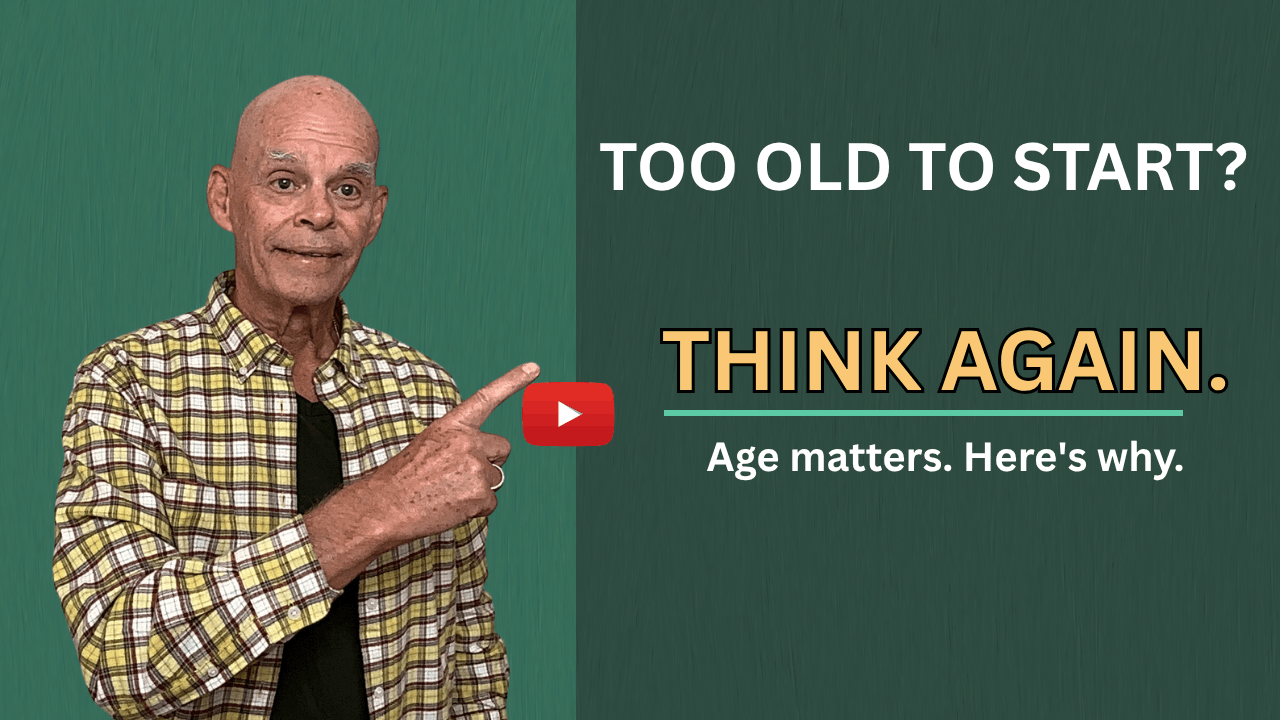
Below, I want to go a layer deeper than the video, into the actual numbers, the fears nobody says out loud, and a simple plan to get moving this week.
Age Matters: What the Data Says About Senior Entrepreneurs
A few findings worth knowing before you second-guess yourself:
- Higher survival rates. Research from the Harvard Business Review and MIT has repeatedly found that businesses founded by people in their 40s, 50s, and 60s have meaningfully higher long-term survival rates than those founded by people in their 20s.
- More capital efficiency. Older founders, on average, start with more personal savings and are less reliant on outside investors, meaning fewer strings attached and more control.
- Stronger initial networks. Decades of professional and personal relationships translate directly into faster early customers, referrals, and partnerships, something a 20-something founder simply hasn’t had time to build.
None of this means younger founders can’t succeed. It means the “youth is an advantage” assumption doesn’t hold up under actual scrutiny.
The Fears Nobody Talks About (And Why They’re Smaller Than They Feel)
“I’m not tech-savvy enough.” You don’t need to code a website or master software from scratch. Today’s tools are built for non-technical users, and most successful senior-run businesses lean on simple, guided platforms rather than custom-built tech.
“I don’t have startup capital.” Most senior-friendly business models (consulting, coaching, content, licensing expertise) can be started for under a few hundred dollars, no loan, no investor, no risk to your retirement savings.
“What if I fail and everyone sees it?” Most first-time businesses are quiet, low-visibility experiments before they’re public successes. You control how loudly, or quietly, you start.
Business Models That Fit Senior Entrepreneurs Especially Well
- Consulting — monetizing decades of industry expertise directly
- Coaching or mentoring — especially in a field you spent a career in
- Content creation — teaching what you know via video, writing, or courses
- E-commerce or a niche product line — often run part-time, at your own pace
- Licensing or advising — getting paid for your knowledge without running day-to-day operations
Each of these can start small, scale slowly, and doesn’t require you to quit your current lifestyle overnight.
A Simple First-Week Action Plan
You don’t need a business plan yet. You need momentum. Here’s a low-risk way to start:
- Day 1–2: Write down 3 things people have paid you for advice on, formally or informally, over your career.
- Day 3: Search whether others are already doing something similar online (this is a good sign, not a bad one, as it proves demand).
- Day 4–5: Talk to 2 people in your existing network about the idea. Ask what they’d pay for it.
- Day 6: Take a free business-fit assessment (like the one linked below) to get a personalized starting point.
- Day 7: Write one piece of content — a post, a video, an email — sharing what you know. That’s your first real step.
FAQ: Starting a Business After 60
Is it too late to start a business at 60? No — data shows entrepreneurs over 55 have some of the highest business survival rates of any age group, often outperforming founders in their 20s and 30s.
What business can a 65-year-old start with little money? Consulting, coaching, content creation, and licensing expertise are among the lowest-cost, lowest-risk options, often startable for under a few hundred dollars.
Do I need to be tech-savvy to start an online business as a senior? No. Most modern platforms are built for non-technical users, and guided tools handle the technical side for you.
What’s the biggest advantage older entrepreneurs have over younger ones? A deeper network, sharper judgment from experience, and a stronger tolerance for evidence-based decisions rather than emotional ones, explained in more depth in the video above.
Ready to Take the Next Step?
If the idea of building something new, on your terms, at your pace, feels exciting rather than exhausting, the best next step is a free, no-pressure assessment to find the business model that actually fits you.
And if you haven’t watched the full video yet, it walks through exactly why age works in your favor- worth 8 minutes of your time before you decide anything.
—
Want to stay up to date on new posts just like this one?
and get the latest posts automatically via email

Jan O. Nilsson –Age Matters When Starting a Business After 60 — Here’s What the Data Actually Says <== to the top of the page
Follow me: